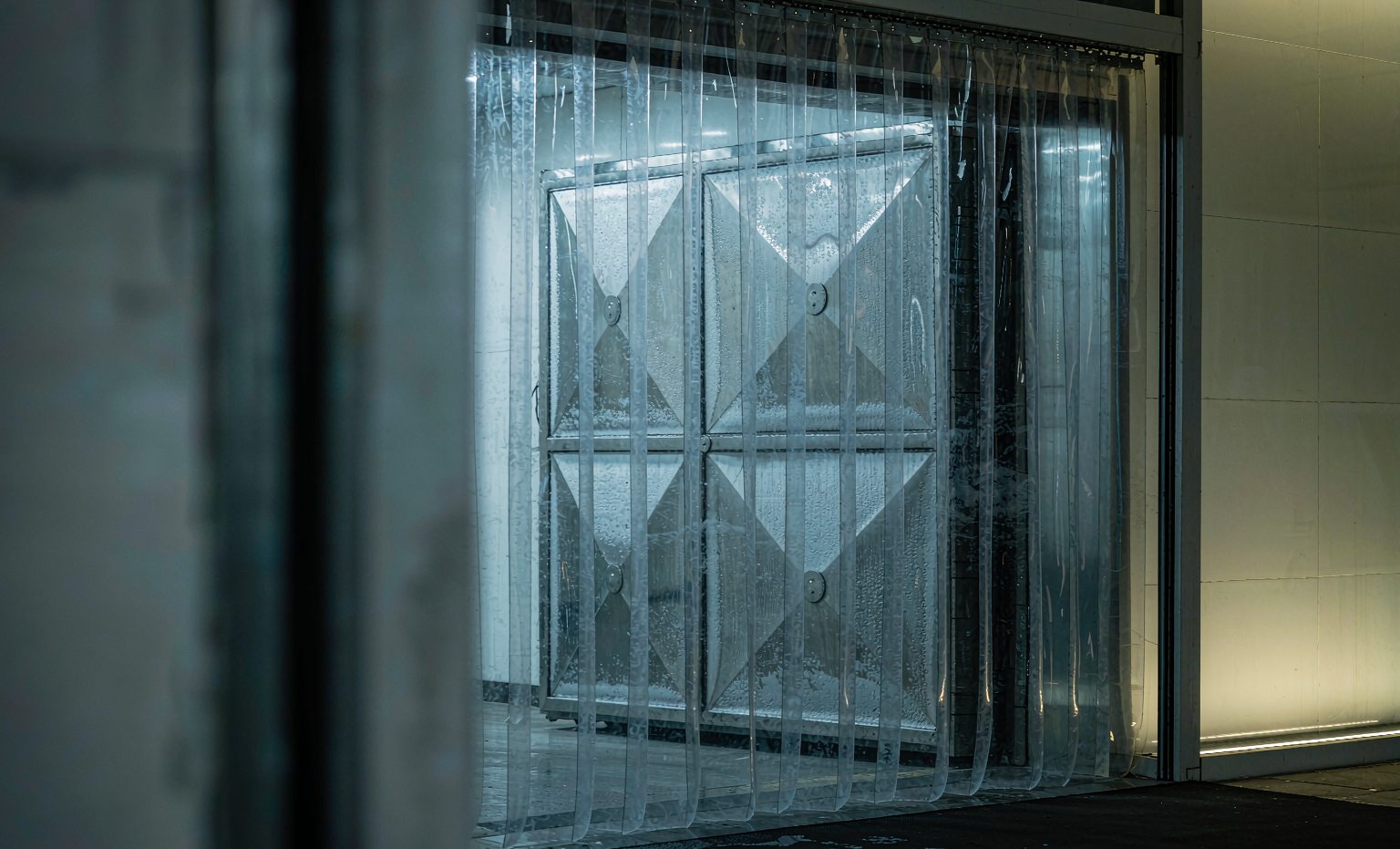
How a cold room curtain actually fails
The failure is not usually a tear — it is stiffness. As the temperature drops, standard DOP-plasticised PVC loses flexibility. Stiff strips no longer fall back into overlap after a trolley pushes through, the door stops sealing, and frost creeps further into the frame. Then, one impact at low temperature, a strip cracks at the punch holes. Everything downstream — ice on the floor, compressor run time, product quality — follows from that first loss of flexibility.
DOTP vs DOP at low temperature
The plasticiser is the softener that keeps PVC flexible, and the two common plasticisers behave very differently in the cold. DOP is the cost-effective standard for ambient doors. DOTP holds flexibility at lower temperatures and additionally offers low migration — relevant for food contact and indoor air quality. For freezer and chilled doors, the specification is simple: DOTP compound, and stop worrying about the first cold snap.
What to write on the enquiry. Door temperature (chilled 0–8 °C or frozen below −18 °C), traffic per hour, and whether the strips are washed down. Those three lines let the manufacturer pick the compound and thickness in one reply.
Specifying the freezer doorway
Beyond the compound, three details decide how a cold room curtain performs:
- Width and overlap. Narrower strips (200–300 mm) with generous overlap re-seal faster after push-through — important where the door cycles constantly.
- Ribbed strip for traffic. Ribs stop cold-stiffened strips sticking face-to-face, the same trick that works on high-traffic ambient doors.
- Magnetic self-closing for pedestrian doors. Edge magnets pull the curtain shut after each pass — useful in supermarket and warehouse cold aisles where nobody stops to straighten the strips.
What the curtain is worth
An open or poorly sealed cold door is a heating system running in reverse: warm air pours in at the top, cold air spills out at the floor, and the evaporator fights the mix. A correctly spec'd curtain shortens the time the doorway is effectively open to seconds per crossing. In energy terms the curtain usually pays for itself within months in a busy cold store — before counting the reduced ice maintenance and the more stable product temperature.